

Gujarat Pilgrimage for Senior Citizens: Pace, Mobility and Health Guide
A candid readiness guide for comparing the 4-day and 10-day routes, arranging mobility help, carrying medicines and avoiding an exhausting schedule.
Senior-friendly should describe the actual traveler–itinerary match, not function as a blanket promise.
Quick answer
The 4-day Somnath–Dwarka route is the more manageable choice for many seniors because it has fewer hotel changes and avoids the full cross-state road circuit. The 10-day route can still work for a medically stable traveler who tolerates long coach journeys and regular walking. Before choosing, assess standing time, vehicle sitting, steps, toilet frequency, medicine timing and whether the traveler needs continuous assistance—not age alone.
Key takeaways
Planning visual
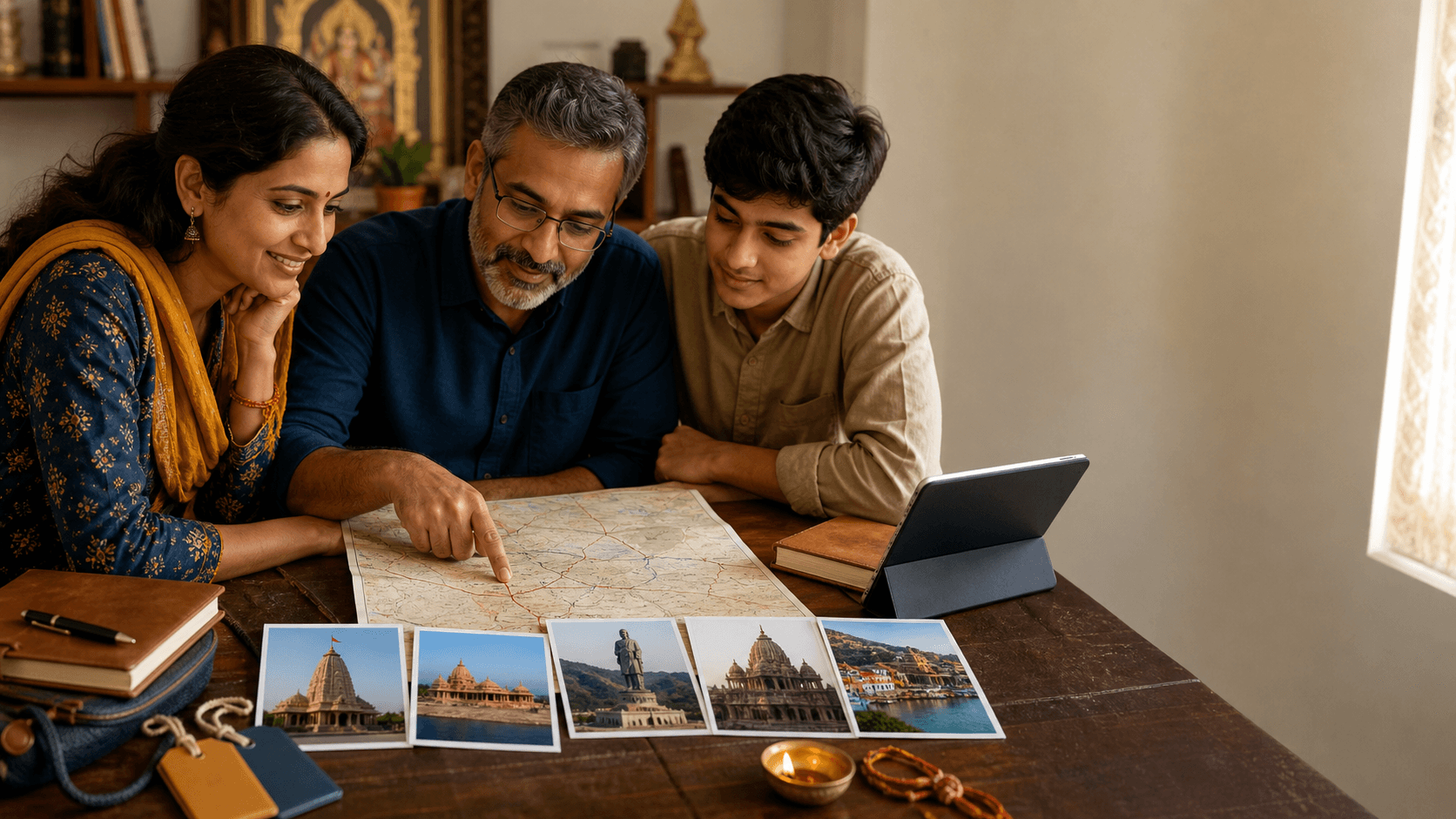
Generated planning visual for comparing Gujarat route pace, temple clusters and departure comfort.
Begin with function, not the number on the birth certificate
Two travelers of the same age can have very different trip capacity. Ask how long the person can sit in a coach without significant pain, stand in a slow queue, walk from a vehicle drop-off to a temple entrance, manage stairs and use an unfamiliar washroom independently.
Also consider recovery. A traveler may complete one demanding day but struggle when a similar day follows immediately. The 10-day circuit has repeated early starts, hotel changes and long transfers, so consistent stamina matters more than one good outing at home.
Compare the 4-day and 10-day routes honestly
The shorter trip concentrates on Dwarka, Bet Dwarka, Nageshwar, Porbandar and Somnath. It reduces the number of hotel changes and avoids the Gujarat-to-Madhya Pradesh overland section. It is usually the better first pilgrimage for someone returning to travel after illness, surgery or a long inactive period—but medical clearance still belongs with the treating clinician.
The 10-day circuit adds important destinations, including the Statue of Unity, Ujjain and Omkareshwar. It also adds an eight-to-nine-hour Ahmedabad–Dwarka day and other long transfers. Choose it because the four Jyotirlingas matter enough to justify the pace, not simply because more places are included.
Mobility assistance must be arranged stop by stop
Somnath Trust officially lists wheelchairs or a golf cart from the main gate and lift access within the premises. That is encouraging, but it does not prove that all temples on the circuit offer the same facilities or that assistance will be instantly available during a crowd peak.
For flights, India’s civil-aviation accessibility guidance recognizes different wheelchair-assistance levels, including help across the ramp and for passengers who cannot manage steps. Tell the airline the actual need during booking—for example, long-distance wheelchair help versus inability to climb aircraft stairs—and reconfirm before departure.
Medicines, meals and long travel days
Keep all routine medicines in hand baggage, in original labelled packs, with a written list of generic names, doses, allergies and the treating doctor’s contact. Carry enough for the journey plus a small delay buffer. Do not experiment with a new sleeping tablet or motion-sickness medicine without medical advice, especially when several medicines are already prescribed.
On coach days, regular hydration and movement breaks help comfort, but fluid advice may be different for heart or kidney conditions—follow the treating clinician’s plan. Keep a simple snack that suits diabetes or medicine timing even when group meals are included. The family should know where emergency contact and insurance details are stored.
A better definition of senior-friendly
A genuinely senior-considered trip explains road hours, walking, stairs, meal timing, room access and optional activities before booking. It allows a traveler to skip a non-essential stop without guilt and provides a clear way to contact the tour manager if the person needs rest.
No itinerary can guarantee that every temple queue will be short or every attraction will be step-free. The useful question is whether the plan has enough flexibility, assistance and family support for this particular traveler. When in doubt, reduce the route before increasing the support complexity.
Video idea
A five-question senior readiness check for Gujarat
A respectful family decision guide that focuses on independence, recovery and support needs.
Common questions
What is the better Gujarat package for most senior citizens?
The 4-day Somnath–Dwarka route is usually easier because it has fewer hotel changes and avoids the longer two-state circuit. Individual health and mobility still decide suitability.
Are all Gujarat temples wheelchair accessible?
Do not assume that. Somnath officially lists wheelchair, golf-cart and lift help, but access conditions vary by temple and can change with crowd-control arrangements.
How should medicines be packed for the trip?
Keep them in hand baggage in original labelled packs, with a written medicine and allergy list, plus extra supply for reasonable delays. Ask the treating clinician about timing or storage concerns.
Can a senior traveler skip Gir safari or another activity?
They should be able to skip optional activities when rest is more valuable. Confirm in advance where the traveler can safely wait and who will remain available to assist.